Protests took place in Tel Aviv, Jerusalem, Haifa, and Beersheba, as a survey found broad but uneven support among Jewish Israelis for Operation Roaring Lion.
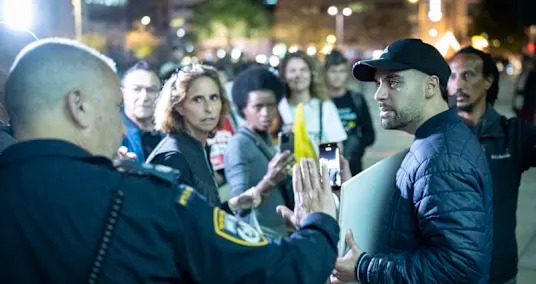
Israel Police arrested 21 anti-war protesters Saturday night as demonstrations against the conflict with Iran expanded in multiple cities despite restrictions on public gatherings.
Protests took place in Tel Aviv, Jerusalem, Haifa, and Beersheba, with hundreds of participants reported in Tel Aviv and Jerusalem and about 100 in Haifa, marking the largest turnout since weekly demonstrations began. Authorities said 13 people were arrested in Tel Aviv and eight in Haifa.
Police said the gatherings were not approved under Home Front Command regulations that ban events with more than 50 people. Officials said the increase in turnout followed calls by groups opposing the government to protest despite the restrictions.
“During a situation assessment that took place at the scene with a Home Front Command representative… it was clarified that there was a real risk to human life and accordingly, Yarkon [precinct] police commander Tzachi Sharabi ordered the gathering to be dispersed,” police said.
Hadash-Ta’al chairman Ayman Odeh, an Arab lawmaker involved in the protests, criticized the police response, calling officers fascists “in the service of the government” and saying they were afraid of “the heroic citizens who went out, despite everything, to make their voice heard.”

Survey shows broad, uneven support for war
The demonstrations come as a March 2026 survey by the Israel Democracy Institute found broad but uneven support among Jewish Israelis for Operation Roaring Lion. Support was strongest on the Right at 87% and about half on the Left.
The survey also found that Jewish and Arab respondents largely agreed that Iran’s resilience has been stronger than expected. Most Jewish respondents said Israeli society could sustain the campaign for up to one month, while 28% said as long as needed. Arab respondents were less optimistic about how long the public could endure the conflict.
A majority of Jewish respondents said Prime Minister Benjamin Netanyahu’s decision was driven by security considerations, while most Arab respondents viewed it as political.
LATEST POSTS
- 1
 Early Thanksgiving week forecast: Where Americans can expect cold, rain and snow for the holiday
 - 2The face is familiar, the name might not be. The king of "Hey, it's that guy!' roles is ready to show you his next act.
- 3Accor signs agreement to transform El Gouna resort as Sofitel
- 4Exploiting Unsold Rams: May Be Less expensive Than You Suspect
- 5Israeli forces kill one person in series of attacks on southern Lebanon





- The Rhythms of the Street: Shipping's Tune in the Economy's Symphony
- Air India chief resigns 10 months after devastating Ahmedabad crash and amid mounting financial troubles
- How much would you pay to meet a Real Housewife? At BravoCon, the limit does not exist.
- Couch Styles of 2024: What's Moving
- Top German court to rule on claims by Wirecard shareholders
- German mid-sized firms gloomy on outlook, survey finds
- UN estimates over 2,000 Sudanese pregnant women have fled el-Fasher to escape conflict
- What to watch for in weight loss drugs in 2026
- 'Euphoria' releases Season 3 photos with Zendaya, Sydney Sweeney, Jacob Elordi and others: See them