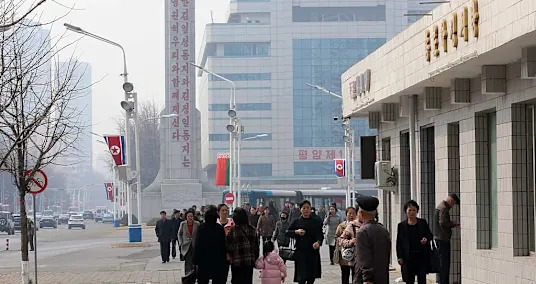
China has announced that its flag carrier, Air China, will resume direct flights to North Korea after a six-year pause, following the restoration of passenger train services between Beijing and Pyongyang.
This marks a significant step toward reopening North Korea, one of the world's most isolated nations, to the world.
Transport links between the two capitals had been suspended since the start of the Covid-19 pandemic in 2020, when Pyongyang implemented a very strict border closure.
While North Korean carrier Air Koryo already resumed flights to Beijing in 2023 and allowed Russian tour groups to visit in 2024, the return of China's air and railways are seen as a major economic milestone, as China has for decades been the main trading partner and a key source of diplomatic and economic backing for the country of 26 million people.
Before the pandemic, there were an estimated 300,000 foreign visitors in 2019, according to South Korea's Institute for International Economic Policy, and Chinese visitors accounted for 90% of all tourists to North Korea. Therefore, the long delay in resuming regular travel had surprised many regional observers.
"The reopening of these borders has been driven primarily by Pyongyang's timeline, which challenges the outdated assumption that Beijing dictates terms to a dependent client state," Seong-Hyon Lee, a visiting scholar at the Harvard University Asia Centre, explains.
Related
Nuclear ambitions complicated the relationship
Despite being Pyongyang’s primary ally, Beijing has frequently voiced disapproval over the North's persistent missile tests and nuclear ambitions. This aspect created a bumpy relationship with Pyongyang, with analysts saying that a nuclear-armed North Korea has often been something of a liability.
The diplomatic normalisation was highlighted last September, when Kim Jong Un attended a massive military parade in Beijing alongside Russian President Vladimir Putin. This was Kim's first appearance at a Chinese military display.
Lim Eul-chul, a North Korea expert at South Korea's Kyungnam University, argues that the war in Iran, in particular, increased "the need for closer coordination between the two nations".
LATEST POSTS
- 1
 7 Powerful Methods for forestalling Telephone Overheating: Keep Your Gadget Cool
 - 2Ukraine confirms defence and energy ministers at second attempt
- 3Best Food Truck Cooking: Decision in favor of Your Number one!
- 4How Would You Like to Deal with Your Funds?
- 5IDF Home Front Command extends siren warning times for Hezbollah rockets in North




- Former hostage Eitan Mor on Hamas: ‘They will not give up until the last Israeli is gone'
- Infants will no longer receive hepatitis B vaccine at birth, CDC announces
- Share your number one city visit transport that leaves a mark on the world wake up!
- Trial of pro-Palestine activist begins
- Kona SUV: The Courageous Minimized That is Catching Hearts Around the world
- Mummified cheetahs found in Saudi caves shed light on lost populations
- NASA counts down for first crewed lunar mission in half a century
- Gaza Strip sees flooding after heavy rainfall
- Intriguing Strange Cruising Objections you Should Visit