SIOUX FALLS, S.D. (KELO) – As the war with Iran continues, people here at home are feeling the impact.
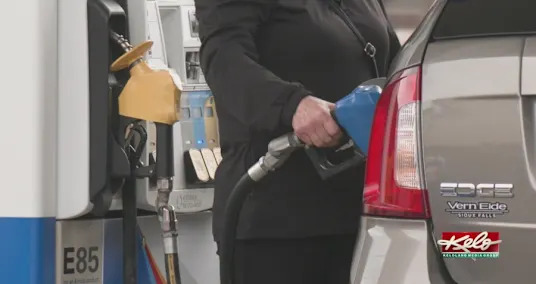
Perhaps the place most of us continue to feel the impact of the war is at the gas station.
Brookings authorities: Pub Crawl exceeds Hobo Day arrests
“Gas is definitely taking up a lot more of my money that it was before,” Jacob Smith Mendez from Sioux Falls said.
And people who work in the food delivery service, like Caden Iken, might feel it even more.
“The amount of gas that you’ll get with ten dollars, twenty dollars, is a lot different than when it used to be two dollars,” Iken said. “So, I mean, that’s cutting into my profits and how much money I make and how far I can drive.”
The higher prices are due in part to the disruption of crude oil being transported through the Strait of Hormuz
“But not only that, there’s a number of different essential products out there also. And, just to put this in to context, it’s the third major supply chain disruption that we’ve been experiencing,” Evert Van der Sluis, a professor of economics at SDSU, said. “You know, we had COVID a few years ago and then we had Russia’s invasion of Ukraine. We learned from those previous two occasions that even a short blockage can really mess up the global supply chains but this may be the big one. This might be a much bigger disruption.”
And it’s unclear how long that disruption will last.
“There are some people who say that if this conflict lasts, if it drags on, then oil prices could get a lot higher,” Van der Sluis said. “And that’s not just oil prices and gasoline prices, but it’s everything else that depends on oil — transportation, you know, trying to find an airline ticket somewhere and all of that. That’s going to have a negative economic affect, no doubt.”
In the meantime, everyday Americans are doing what they can to afford the prices at the pump.
“Whatever I need, you know, right now I’m at half a tank so I just put ten dollars in, get me around the city, get me to the job,” Smith Mendez said.
Farmers are also feeling the impact of the war with disruptions in fertilizer also coming through the Strait of Hormuz.
Van der Sluis went much more in-depth with us about the impacts the war is having on the economy and consumer spending. You can catch more of that conversation this Thursday at 6:30 during Your Money Matters More on KELOLAND Plus.
If you’d like to track the gas prices in your area, click here.
Copyright 2026 Nexstar Media, Inc. All rights reserved. This material may not be published, broadcast, rewritten, or redistributed.
For the latest news, weather, sports, and streaming video, head to KELOLAND.com.
LATEST POSTS
- 1
 Heavy rain, floods kill at least 45 people in Afghanistan, Pakistan
 - 2Artemis 2 breaks humanity's all-time distance record during historic loop around the moon (video)
- 3From Overpowered to Coordinated: Individual Accounts of Cleaning up
- 4Journalist reported killed in the Gaza Strip
- 5Favored Organic product for Seniors' Prosperity: Make Your Determination


- Ariana Grande to host 'Saturday Night Live' Christmas show with Cher as musical guest, returning after nearly 40 years
- The Best 15 Applications for Efficiency and Association
- I binged all 24 Hallmark Christmas movies in less than 30 days. I emerged a changed man.
- 7 Fun Plans to Make Film Evenings Seriously Energizing (You'll Cherish #5!)
- Manual for Tracking down One of a kind Store Inns
- NASA releases new photos of interstellar comet 3I/ATLAS
- Exposure to neighborhood violence leads some Denver teens to use tobacco and alcohol earlier, new study shows
- NASA just launched Artemis 2. What happens today could make or break the moon mission
- NASA’s Pandora telescope will study stars in detail to learn about the exoplanets orbiting them